
Michael Pitt
Particle Physicist • Researcher at CERN
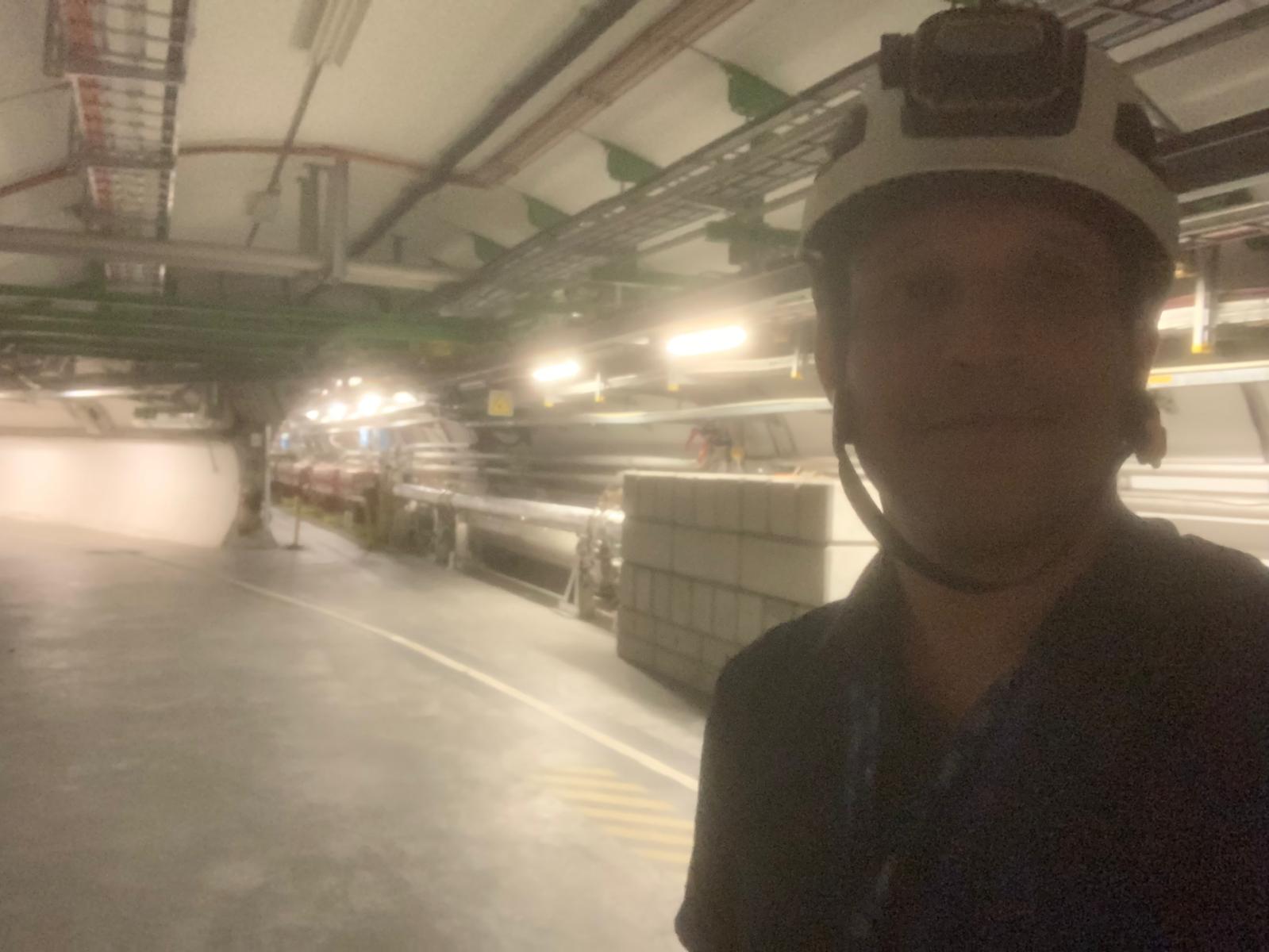
I am a physicist at CERN, where my research focuses on exploring the fundamental principles of nature. By studying the high-energy collisions produced at the Large Hadron Collider (LHC), I study the interactions of elementary particles to understand how the fundamental forces shape the properties of matter and to investigate the mechanisms underlying the formation and evolution of the universe we observe today. Combining theoretical insights with experimental data, these studies aim to provide a deeper comprehension of the building blocks of nature and the dynamics that connect them.
While at CERN, I became fascinated by the fact that light can interact with light (yes, electromagnetic waves scattering off one another). Under certain conditions, the Large Hadron Collider effectively operates as a photon collider .
Since then, my research has centered on photon collisions, as well as in diffractive processes. You can read more about my research at CERN in our CERN Courier article: CMS looks forward to new physics with PPS .
Experimental particle physics encompasses sophisticated data analysis as well as contributions to the design, construction, and commissioning of particle detectors for current and future high-energy physics experiments. The goal is to reveal hidden interactions through advances in experimental techniques, paving the way for new and more sophisticated experiments.
Today, within the CMS experiment, efforts are focused on extending detection capabilities with new particle detectors.
Photon collisions at the LHC
To hunt for photon collisions at the LHC, one needs to look for a distinct signature: the protons that emit photons can remain intact, and the only particles produced come from the photon–photon interaction, resulting in no hadronic activity when the protons collide. This is a big challenge at the LHC, as many proton–proton interactions can happen during a single bunch crossing. In CMS, we developed a method to isolate such collisions and reveal rare photon–photon events:
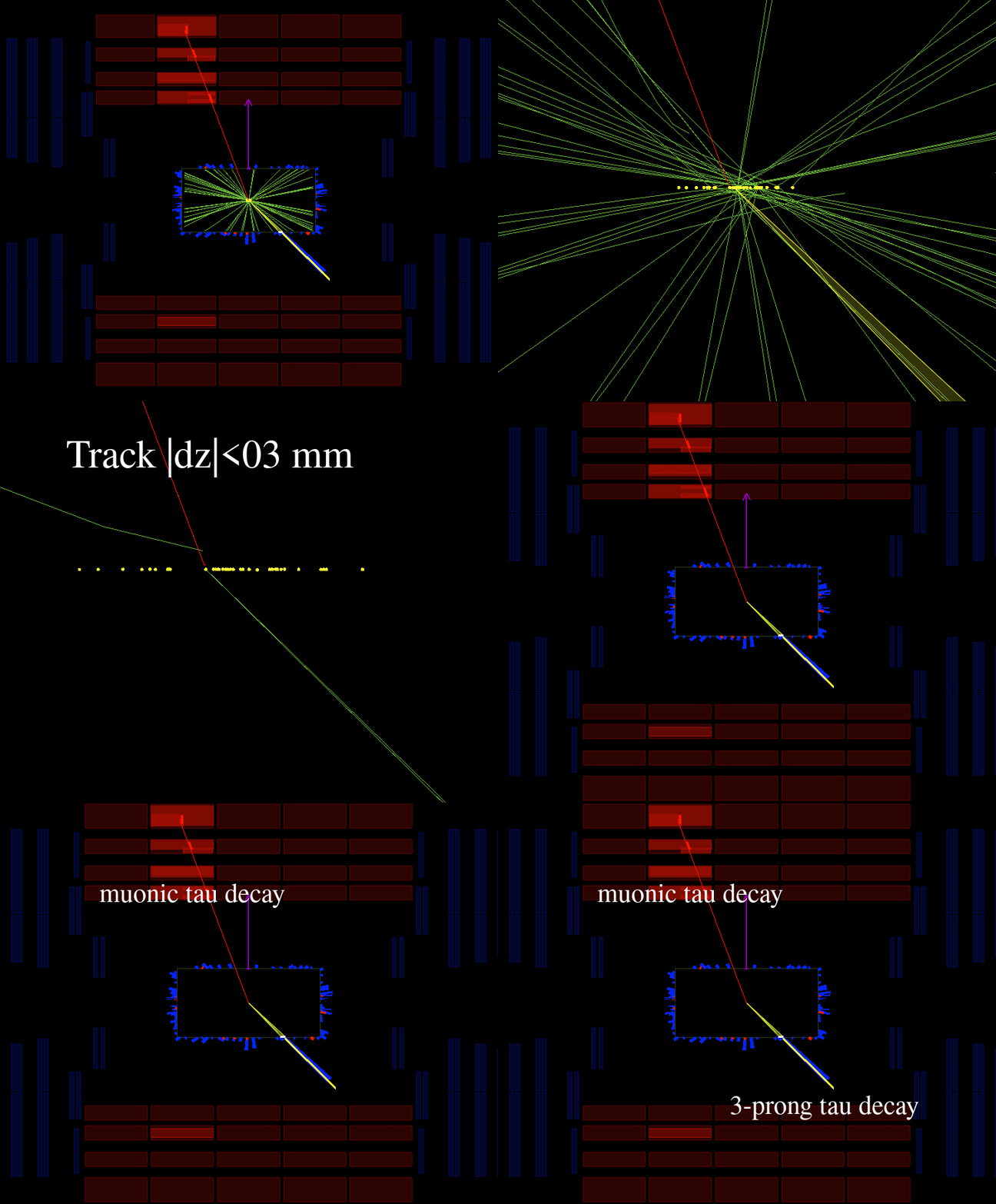
In our study of the anomalous magnetic moment of the τ lepton, where we significantly improved a 20-year-old result, moving closer to determining the τ g−2, we developed a robust methodology to study these processes at the LHC ( CMS closes in on tau g−2 ).
Diffractive interactions at the LHC
Photon exchange is not the only way protons interact. They also interact through the strong force, whose behavior is richer and less intuitive. Protons are quantum objects with wave-like properties, and when they scatter, the distribution of their scattering angles can show a diffractive structure, reminiscent of light scattered by an object. Because both beams are made of protons, each proton is at once the projectile and the target whose internal structure is being probed.
A proton carries electric charge, but as a whole it carries no net color charge (the charge associated with the strong force). Nevertheless, protons can scatter through both electromagnetic and strong interactions. These interactions leave different diffractive imprints: electromagnetic scattering traces the distribution of electric charge, while strong scattering probes the region over which the proton interacts through QCD. This makes even a simple question such as “how large is the proton?” depend on how the proton is probed. The deeper puzzle is how a color-neutral proton can interact through the strong force and still survive the collision.
What is a Pomeron?
The answer starts inside the proton. Its quarks and gluons carry color, and their color charges combine so that the proton as a whole is color-neutral. In a diffractive collision, two protons can exchange momentum without exchanging net color, allowing one or both protons to remain intact. At high energies, physicists often describe this color-neutral strong exchange as Pomeron exchange. Connecting this effective description to the underlying quarks and gluons remains a big challenge.
Can a proton survive an energetic collision?
Low-momentum elastic scattering is only the beginning. The more stringent question is whether a proton can survive when the same collision also produces a hard scale, such as a heavy boson or very energetic jets. In our recent CMS study, we observed W and Z bosons, as well as multijet systems reaching the TeV scale, produced together with tagged intact protons. This opens a new way to study diffraction in high-energy collisions. Read about our result.
Selected research highlights
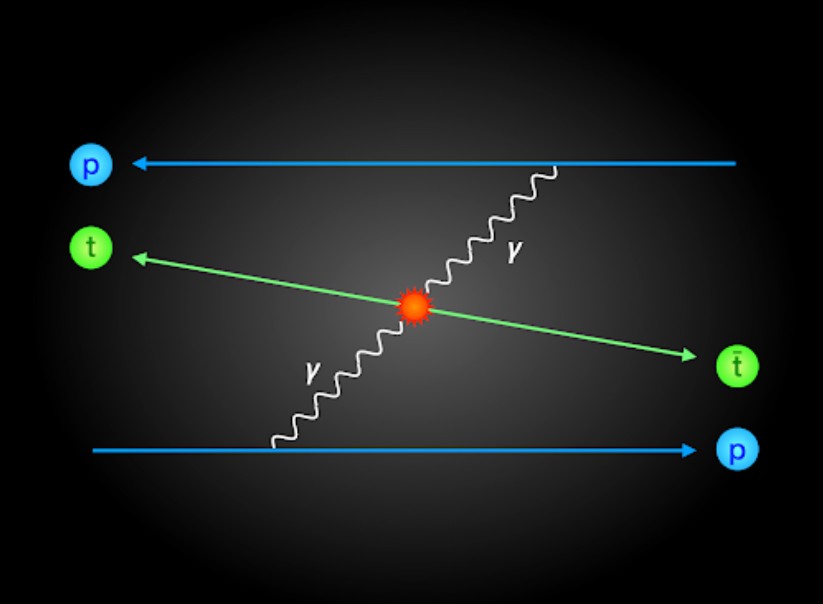
Detecting the creation of top quarks out of light
April 2022
Unveiling rare processes where photons produce top-quark pairs.
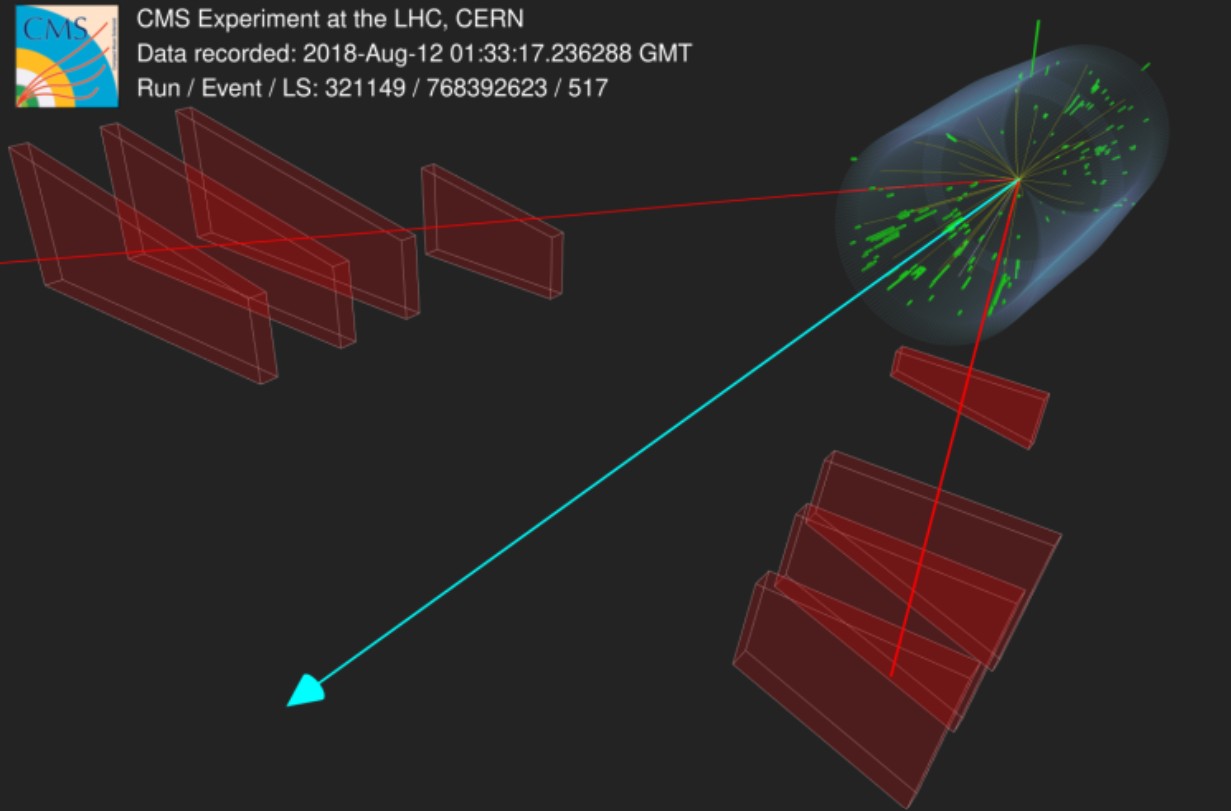
Protons do not break at the LHC
July 2022
Studying collisions where protons stay intact after photon exchange.
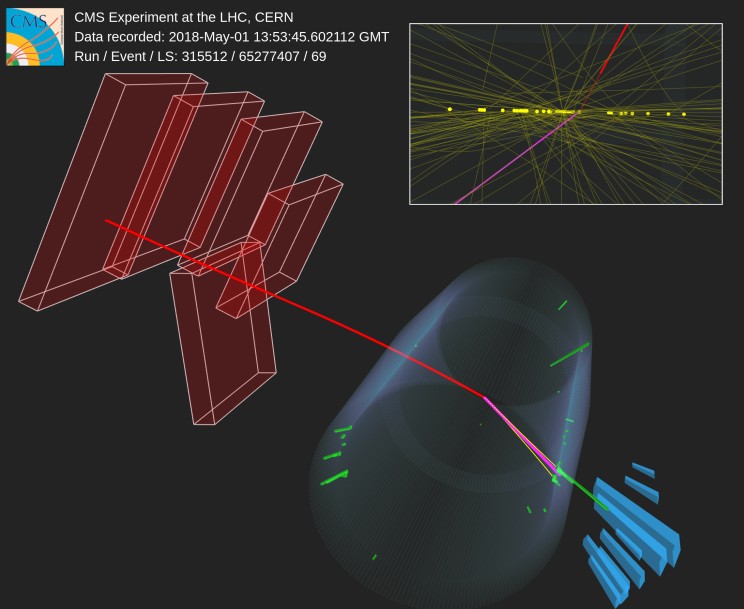
Disclosing quantum corrections to electromagnetic interactions of τ leptons
March 2024
New insights from CMS into τ g−2 via photon-photon collisions.
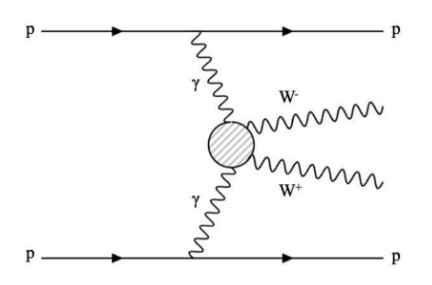
When light turns into weak heavy bosons
September 2025
CMS explores photon–photon collisions producing a pair of W bosons.
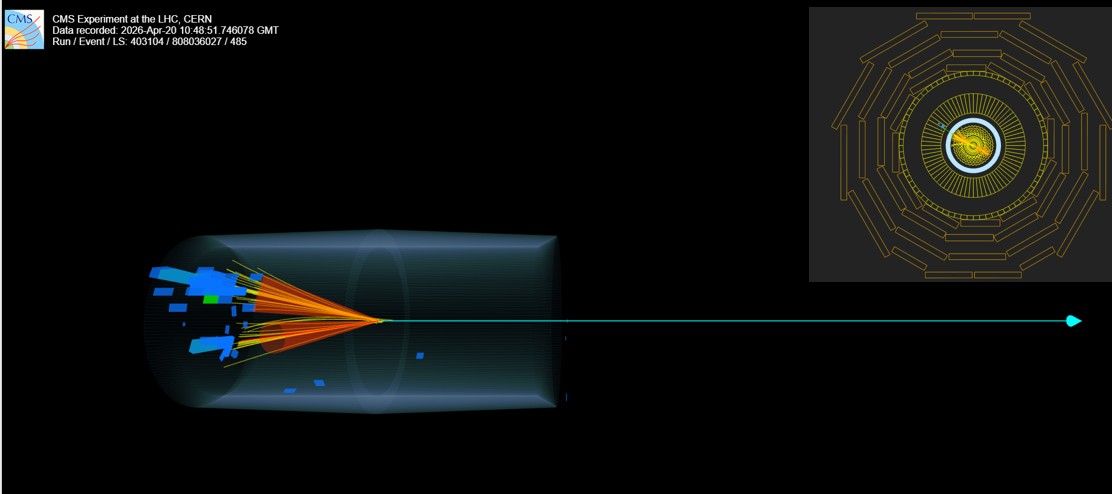
Finding the needle in the pileup
July 2026
CMS revives diffractive physics, tagging intact protons alongside W/Z bosons and TeV-scale multijets.
News
Find my research on: Google Scholar • INSPIRE-HEP • ORCID
Selected Publications
- Observation of the production of high-pT jets or electroweak bosons with an intact forward proton in pp collisions at √s = 13.6 TeV, M. Pitt and the CMS Collaboration, CMS-PAS-SMP-26-015
- Observation of γγ → ττ in proton-proton collisions and limits on the anomalous electromagnetic moments of the τ lepton, M. Pitt and the CMS Collaboration, Rept. Prog. Phys. 87 (2024) 10, 107801
- Measurement and effective field theory interpretation of the photon-fusion production cross section of a pair of W bosons in proton-proton collisions at √s = 13 TeV, M. Pitt and the CMS Collaboration, JHEP 06 (2026) 187
- The CMS Precision Proton Spectrometer at the HL-LHC — Expression of Interest, M. Pitt and the CMS Collaboration, CERN-CMS-NOTE-2020-008